

There are two assumptions explored in the concepts of Symbolic Urbanism. First is the premise that the fundamental task of humanity, throughout all cultures and all of time, is that of spiritual or psychic quest via the increase of conscious awareness. This has both a personal and collective aspect, and is evolutionary in nature; that is, over the centuries, humanity awakens to greater and larger insight. This story of awakening is told in all civilizations through the metaphors and symbols of mythology and religion.
The second premise is that the places we build are reflections of the values we hold, and that the built environment has a basic role to play in that process of awakening. The shape and design of our cities and towns can support the operation of urbanism as inspirational laboratory and classroom of psychic investigation. It is an effort to urbanistically symbolize both the individual and collective process of psychic and spiritual development.
The Intent of Symbolic Urbanism
Symbolic Urbanism is a process of urban design and placemaking with the explicit intent of creating an immersive environment infused with a sense of psychic or spiritual meaning and participation in a story of higher purpose of the spiritual history of humanity. A fundamental question in this process is the discovery of how a site can participate in the larger spiritual story of the ongoing and evolving psychic development of humanity. This is accomplished through the use of sacred geometry and mythic symbolism as foundational elements of the public realm. The general intent of this approach is the creation of lovable places of meaning and memory which can promote not only greater civic community but an immersive environment which acts to enhance psychological well-being, and potentially spiritual development. It is an effort to urbanistically symbolize both the individual and collective process of psychic and spiritual development.
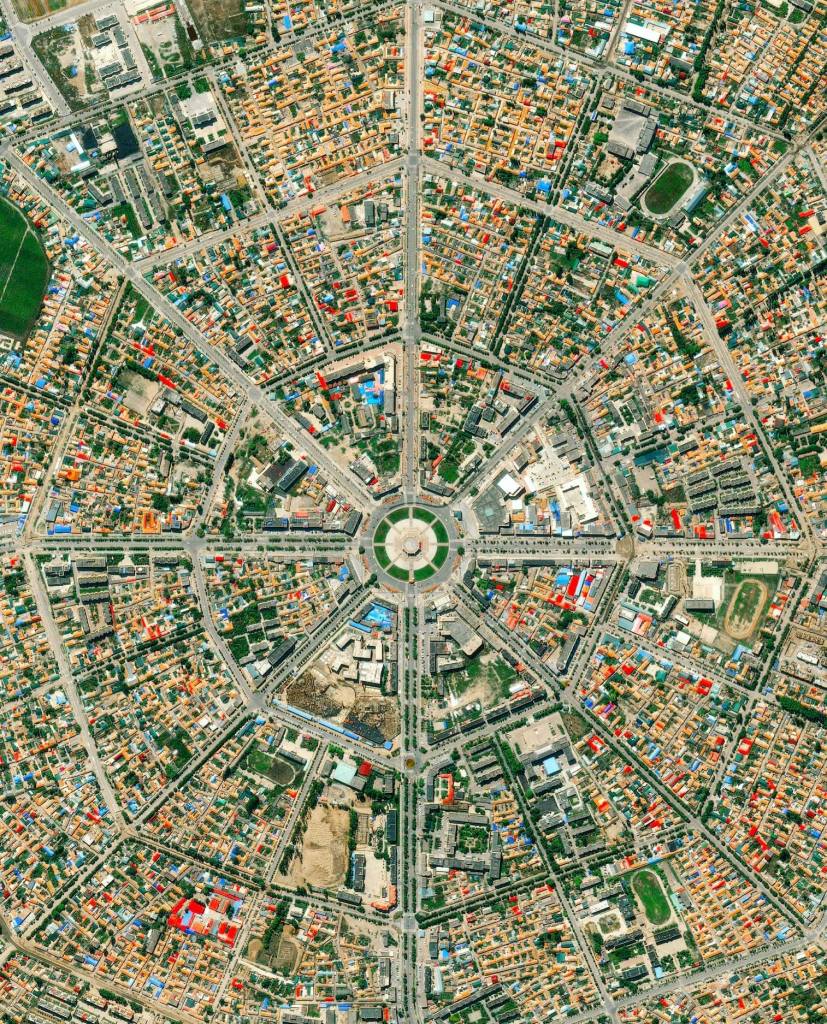
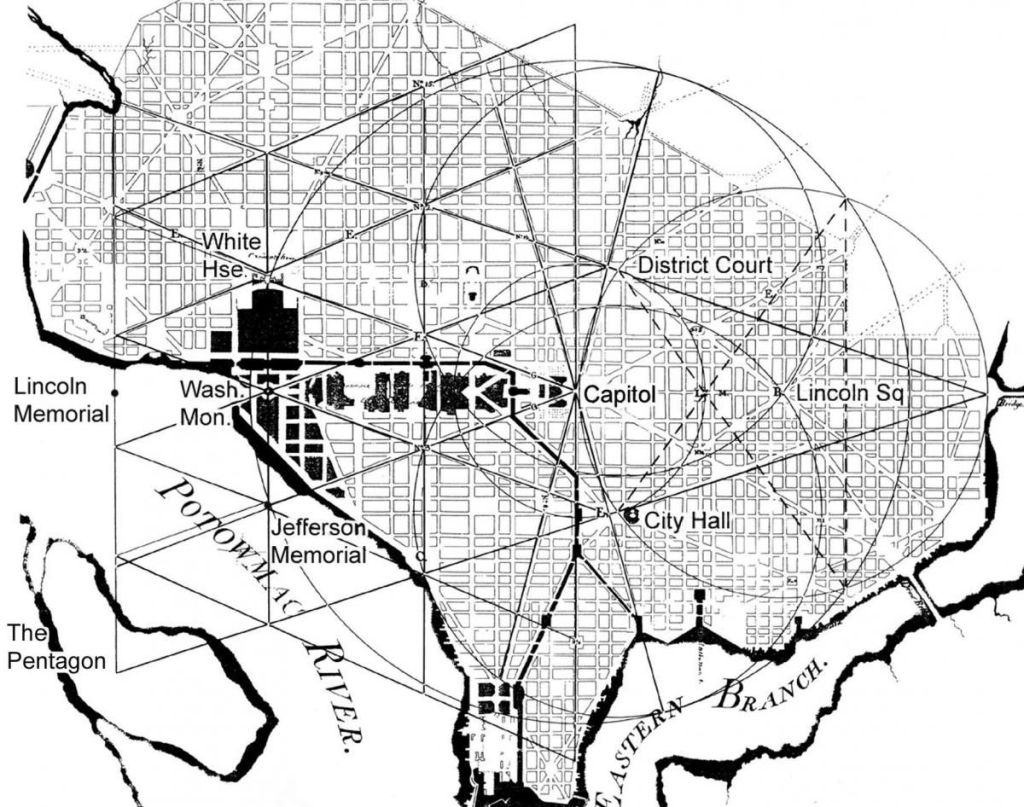
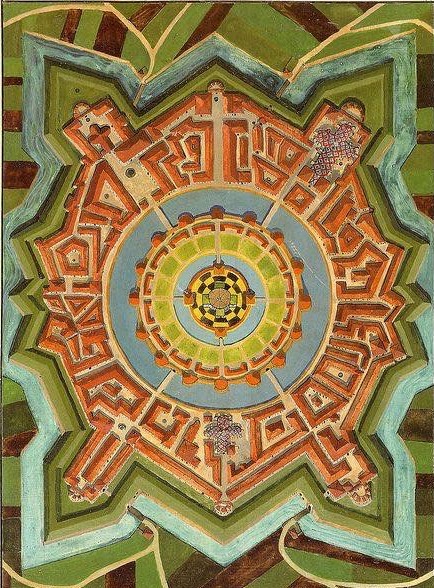
Procedurally, this is accomplished through the initial creation of a symbolic geometric trellis; such trellis is then used for the process of site planning, according to the principles below.
General Principles
The following principles comprise the guide to Symbolic Urbanism. These are not final, are subject to change and refinement, and are not presented in any intentional order.
Grounding
The major alignments, points, and vertices of a geometric pattern must coincide with at least one actual point, line, or intersection pre-existing on the land, else any resulting site plan is mere nonsense. These may include a street crossing, hilltop, or other topographical feature, water course, a significant historic building which shall remain and not be demolished, or other similar feature.
Foundation
The history, form, and energy of the land itself, and the cultural story of the people having used or inhabited the place, will determine which pattern of sacred geometry is to be applied, and what symbols and mythic stories are to be expressed.
Structure
Symbolic Urbanism provides the foundational trellis upon which traditional urbanism, best exemplified in the Charter of the New Urbanism, can be structured.
Layers
Two levels of experience are built into a Symbolic Urbanism. First, the skeletal arrangement for the street pattern and block layout seen in plan-view; and also the eye-level experience of the pedestrian. In general, the application of sacred geometry is more appropriate at the plan view. The direct human experience of urbanism is enhanced best through symbol, mythic references, and visual metaphor. These two layers interact in a manner so that the more intimate and detailed experience helps reveal the larger pattern.
Unification
These two layers, of geometric patterning and eye-level experiential embellishment, present a set of symbols and metaphors which are coordinated and relate a single theme of story or related stories, drawn from a single or closely related sources. In other words, a mixing of traditions and metaphors is discouraged unless they reveal complimentary narratives.
Commingling
Symbolic Urbanism is the coming together and commingling of the rational and intuitive.
Scale
Symbolic Urbanism functions at all scales, from the larger vision of regional and multi-acre site planning, the intermediate scale of street dimensions, block size and dimensions, park and plaza layout, and the smaller scale of decorative building façade design and street furnishings.
Mutuality
In its task of promoting a public realm of deeper meaning and intention, Symbolic Urbanism explicitly supports both the realms of shared public religious expression in all its forms and traditions, and privately conducted interior spiritual quest.
Hierarchy
A hierarchy of values and service is understood, as follows:
- Technology is accepted as a useful tool, but only in the service of efficiency;
- Efficiency is essential, but gives way to the higher good of sustainability;
- Sustainability is fundamental, but is best achieved when in the service of lovability;
- Lovable places are fundamentally those holding the emotional content of mythic symbolism, and function in the service of lives of higher meaning and purpose.
Pattern
Creative design emerges out of the appropriately chosen pattern, based upon what is kept and what is erased, emphasized or diminished, explicitly drawn or only implied.
Dimensions
All dimensions, not only those on a flat 2D site plan, may be used as expressions; this includes both elevation (the use of a hill, valley, or grotto, for instance), and time (night/ day, moon cycles, sunrise/set, seasons, tides, zodiac, etc.).
Action
The process of design on the land, as well as its ongoing habitation, includes an appropriately chosen ritual(s) of meaning, memory, and intention.
Points of Memory and Meaning
Significant locations are found in the intersections, angles, centers, edges, or other features of the geometry. They may function as a dispersed civic commons, and are recognized through art, statuary, civic structures, and natural features. Such points may be used to determine street alignments, locations of significant structures, civic amenities, building entrances, architectural features such as towers, or public open spaces. They are intended as locations which ground the community in its civic, cultural, artistic, and environmental heritage, including recent traditions and ancient history; and which act as sources of inspiration and learning.
Immersive Environment
Beyond simply creating and locating specific points, the overall goal is the creation of an immersive environment of psycho/spiritual uplift, emphasizing the essential element of the civic commons.
Visibility
Such points should be visually connected to the greatest extent possible, via street alignments, pedestrian paths, waterways, building alignments, or even through windows and doorways. This reciprocity of sight should connect at least two points if not more. The geometry can be intuitively understood as well as visually observed and experienced. Alternatively, points may be intentionally hidden or obscured from one another if such non-reciprocal visibility promotes or supports a larger intentional purpose of storytelling.
Educational
The chosen patterns and symbols should generally reflect culturally shared or known symbols and myths expressing aspirational truths, not merely a personal or private image of the designers own conscious effort, in keeping with the intent of creating an immersive psychic experience.
Change and Local Expression
Accommodations should be made for ad hoc, temporary, and local grass-roots artistic expressions. A Symbolic Urbanism thus acknowledges impermanence and makes room for change over time, at least in one location.
Formal and Informal Structure
The fundamental pattern of place may be rigidly linear or informally curved in its expression, or some combination of the two. A more structured geometry might represent the conscious ego, while a more free flowing organic form represents the unconscious soul.
Precendent
Local traditions of design and materials are to be respectfully considered and incorporated; but need not be strictly adhered to.
 Symbolic Urbanism